
Europe 'united' in face of Trump's Greenland threats, tariffs, EU chief says
Trump announced a new 10% tariff on several European nations.
LONDON -- European leaders hit back at U.S. President Donald Trump's announcement that he would impose sanctions on nations that deployed small numbers of military forces to Greenland last week, as the president continues his push to acquire the Arctic territory.
Trump said Saturday that a 10% tariff would be imposed on all goods sent to the U.S. from Denmark, Norway, Sweden, France, Germany, the U.K., the Netherlands and Finland.
Trump said the new tariffs will come into force on Feb. 1, and will increase to 25% on June 1. The president said the measures would remain in place until the U.S. is able to purchase Greenland.
Greenland is a self-governing territory of the Kingdom of Denmark. Trump first raised the prospect of acquiring the minerals-rich island in his first term. Danish and Greenlandic politicians have repeatedly rebuffed such proposals.
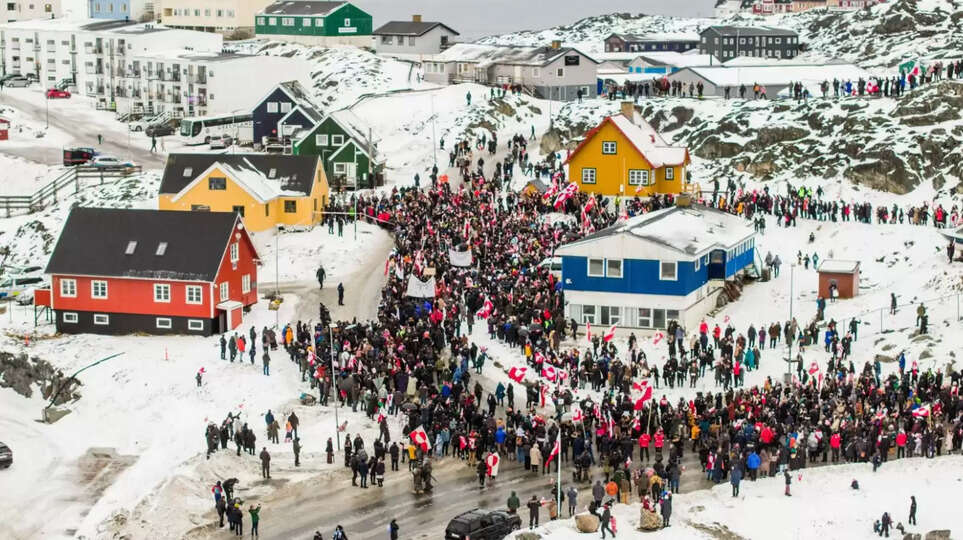
This aerial view shows people as they take part in a demonstration that gathered almost a third of the city population to protest against the US President's plans to take Greenland, Jan. 17, 2026, in Nuuk, Greenland.
European Commission President Ursula von der Leyen on Saturday said the bloc's members will meet Trump's pressure as a united front.
"We have consistently underlined our shared transatlantic interest in peace and security in the Arctic, including through NATO," she wrote in a post to X. "The pre-coordinated Danish exercise, conducted with allies, responds to the need to strengthen Arctic security and poses no threat to anyone."
"Tariffs would undermine transatlantic relations and risk a dangerous downward spiral. Europe will remain united, coordinated and committed to upholding its sovereignty," von der Leyen said.
European Council President Antonio Costa said Sunday that he has "decided to convene an extraordinary meeting of the European Council in the coming days" due to the "significance of recent developments" regarding Greenland.
The statement further said Costa's "consultations with member states on the latest tensions over Greenland reconfirm our strong commitment" to "unity in support of and solidarity with Denmark and Greenland," as well as working with NATO regarding "shared transatlantic interest in peace and security in the Arctic," a "shared assessment that tariffs would undermine transatlantic relations and are incompatible with the EU-US trade agreement," and a "readiness to defend ourselves against any form of coercion" and to "continue engaging constructively with the U.S. on all issues of common interest."
Kaja Kallas, the EU's foreign affairs chief, suggested in a post to X that the escalating tensions between the U.S. and its European allies is a boon for Moscow and Beijing.
"China and Russia must be having a field day," she wrote. "They are the ones who benefit from divisions among allies. If Greenland's security is at risk, we can address this inside NATO."
"Tariffs risk making Europe and the United States poorer and undermine our shared prosperity," Kallas wrote, suggesting the furor was distracting from allied efforts to support Ukraine against Russia's ongoing full-scale invasion.
The eight countries -- all NATO members -- threatened with the tariffs issued a joint statement on Sunday saying they "stand in full solidarity with the Kingdom of Denmark and the people of Greenland."
The statement says tariffs "undermine transatlantic relations and carry the risk of a dangerous downward spiral." The signatories added that they are "committed to strengthening security in the Arctic region as a shared transatlantic interest," and in this context, the planned military exercise in Greenland, "poses a threat to no one."
EU pushback against Trump came alongside criticism from national leaders.
"France is committed to the sovereignty and independence of nations," French President Emmanuel Macron said in a statement Saturday, adding that "no intimidation nor threat will influence us, neither in Ukraine, nor in Greenland, nor anywhere else in the world when we are confronted with such situations."
"Tariff threats are unacceptable and have no place in this context. Europeans will respond to them in a united and coordinated manner if they were to be confirmed. We will know how to uphold European sovereignty," Macron said.
British Prime Minister Keir Starmer said, "Applying tariffs on allies for pursuing the collective security of NATO allies is completely wrong."
"Our position on Greenland is very clear -- it is part of the Kingdom of Denmark and its future is a matter for the Greenlanders and the Danes," he said.
Later Sunday, Starmer spoke with Trump, after speaking with Danish Prime Minister Mette Frederiksen, European Commission President Ursula von der Leyen, and NATO Secretary-General Mark Rutte, according to a statement from the prime minister's office.
"In all his calls, the Prime Minister reiterated his position on Greenland. He said that security in the High North is a priority for all NATO allies in order to protect Euro-Atlantic interests," the statement said, adding that Starmer "also said that applying tariffs on allies for pursuing the collective security of NATO allies is wrong."
Rutte also posted Sunday that he spoke with Trump "regarding the security situation in Greenland and the Arctic. We will continue working on this, and I look forward to seeing him in Davos later this week."
Swedish Prime Minister Ulf Kristersson said discussions are ongoing between the affected nations to build a coordinated response.
"We will not let ourselves be blackmailed. Only Denmark and Greenland decide on issues concerning Denmark and Greenland," he said.
Italian Prime Minister Giorgia Meloni said on Sunday that Trump's decision to impose new tariffs was "a mistake and I do not agree with it."
"The intention of some European countries to send troops, to take part in greater security, should have been understood not as an initiative directed against the United States but rather against other actors," Meloni said.
Meloni said she spoke with Trump "a few hours ago" and "told him what I think."
"A core meeting of the European Union has been organized but I believe that at this stage it is very important to talk to one another and that it is very important to avoid an escalation," she added.
Canadian Prime Minister Mark Carney also posted a statement, writing in part that "Canada supports the principles of sovereignty and territorial integrity universally, including as they apply to Greenland and the Kingdom of Denmark," adding, "as we have consistently stated, the future of Greenland is for Greenland and Denmark alone to determine."
Trump has repeatedly suggested that U.S. sovereignty over the world's largest island is necessary to ensure American security and blunt Chinese and Russian influence in the Arctic region.